Case study / End-to-end UX & Brand
Bringing a family print business into the future
A full platform redesign and brand overhaul for Printed.com — researching, strategising, and designing an end-to-end experience for all types of print customer, with a target of 20% conversion growth.
End-to-end UX
Brand strategy
User research
Product design
Design system
Conversion optimisation
01 — Context & problem
A trusted print business with a platform that hadn't kept pace.
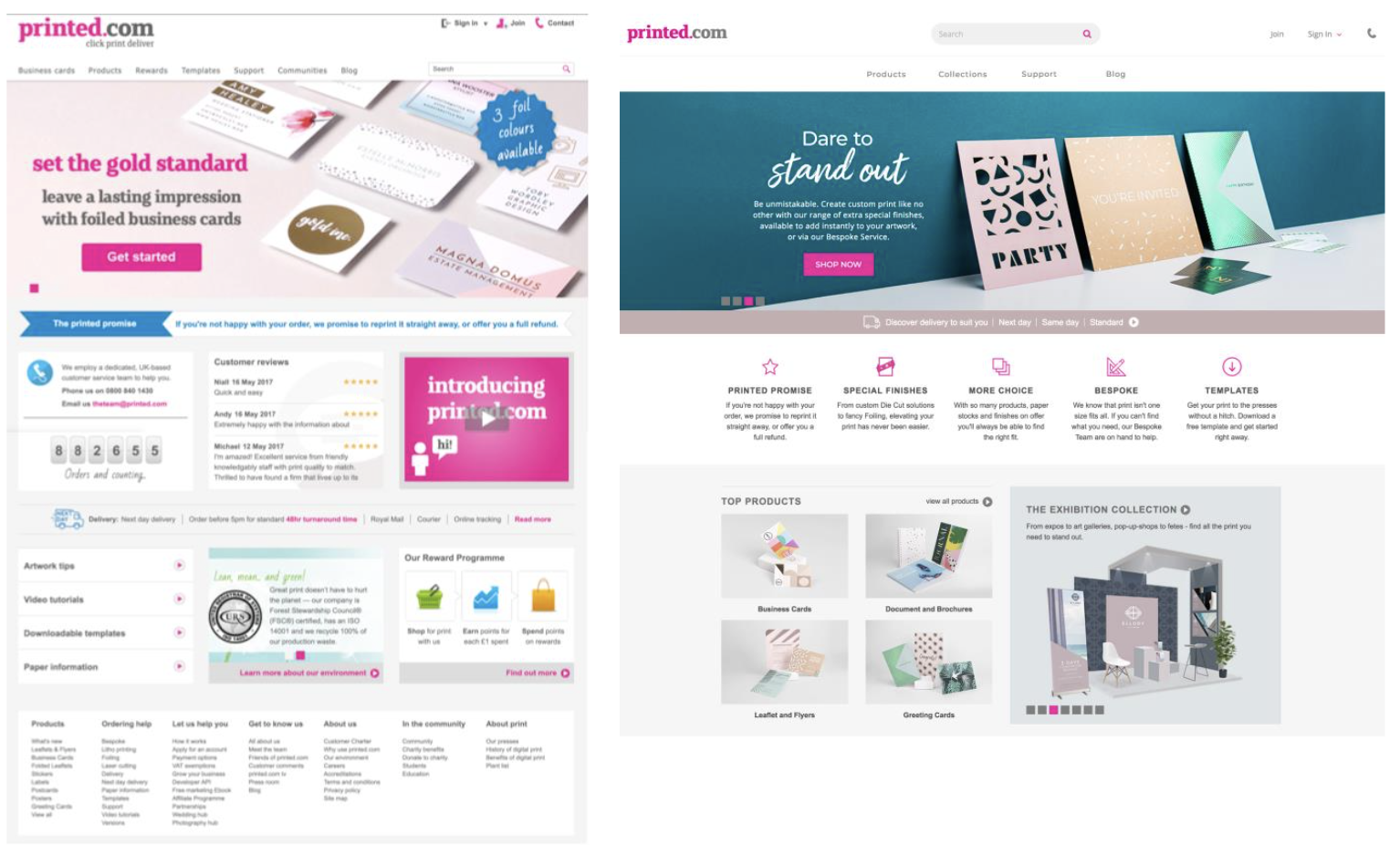
Printed.com is a family-run print company with a loyal customer base and genuinely strong products. But by 2021, the gap between the quality of what they shipped and the quality of the experience on their website had become a real commercial problem.
The platform was built for people who already knew print — seasoned customers comfortable with technical terminology, manual file management, and opaque pricing. New or occasional customers were largely left to figure it out themselves. The brand, too, felt dated relative to where the business wanted to go.
The brief
"Research, strategise and design an end-to-end experience for all types of print customer — with a focus on increasing conversion rates by 20%."
As Head of Design and UX, I led the full project: user research, synthesis, experience design, and managing the simultaneous rebrand — all alongside business-as-usual product work.
Objective
Unify a fragmented, expert-only platform into an intuitive experience for all types of print customer.
Output
End-to-end redesign — brand, product builder, checkout, and account management — launched in 9 months.
02 — Process
Three phases. One continuous thread of customer insight.
The project followed a structured double-diamond process — empathise deeply before committing to solutions, conceptualise before committing to design, and design with a clear strategic brief rather than instinct alone.
Phase 1
Empathise
15+ user interviews conducted
Print forums, Reddit & Facebook groups investigated
Survey sent to existing customer base
Competitor analysis and SWOT completed
Phase 2
Conceptualise
Affinity mapping to cluster insights
Customer pain points prioritised
Customer journey maps created
Synthesis presented to stakeholders
Phase 3
Design
Homepage and product builder prioritised
Branding outsourced to Lovegunn
UX and rebrand managed simultaneously
Mobile-first checkout and product builder
03 — What the research told us
The customers who struggled most were the ones we most needed to serve.
Our research surfaced a clear split: expert customers wanted speed and control, while novice customers needed guidance and reassurance. The platform was optimised entirely for the former — and losing the latter at scale.
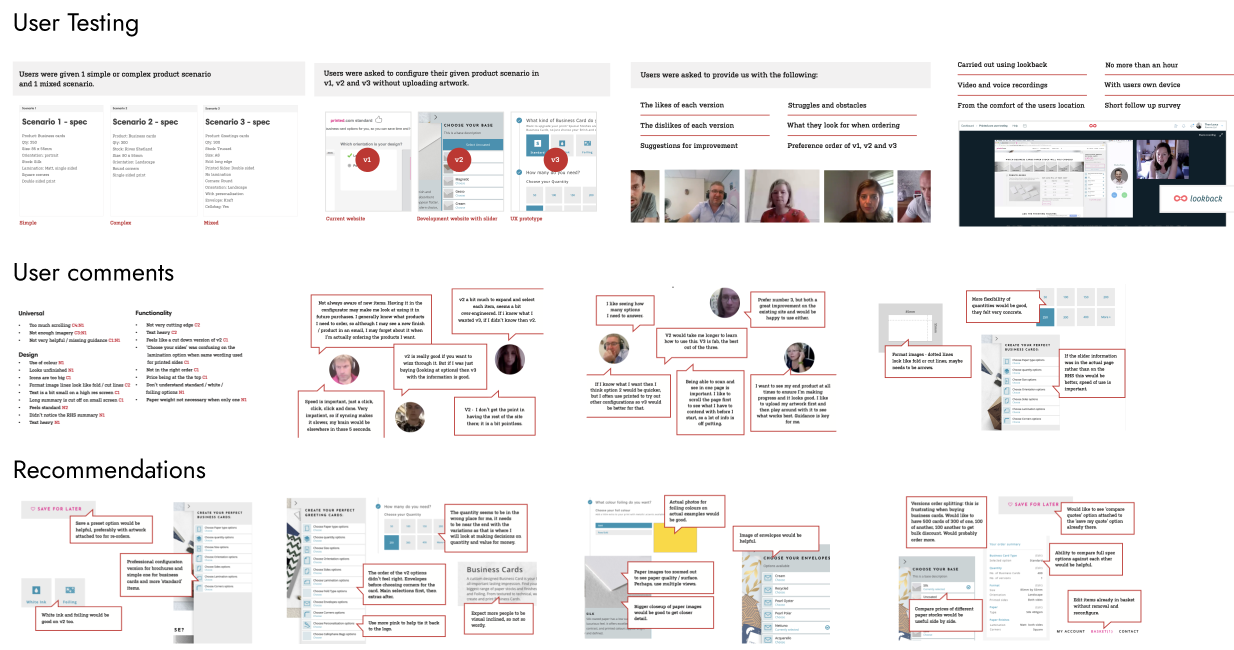
User interviews
Novice users needed support; experts found unnecessary hand-holding annoying. One design had to serve both.
All users wanted live pricing — cost updating in real time as they configured, not at checkout.
Overly technical print jargon was a consistent source of confusion and drop-off.
Customer survey
The majority design their own artwork — making the product builder the most critical interaction in the journey.
Price was the primary decision factor when choosing a print provider. Hiding it until checkout was costing conversions.
Turnaround time was invisible until checkout — a major frustration, particularly for deadline-driven customers.
Affinity mapping
Managing invoices, quotes, and order history was cumbersome — a friction point users had learned to live with.
The site experience didn't reflect product quality. The gap was undermining trust before orders were placed.
Strong customer support was entirely undersold — a genuine competitive advantage not visible in the UX.
Journey mapping
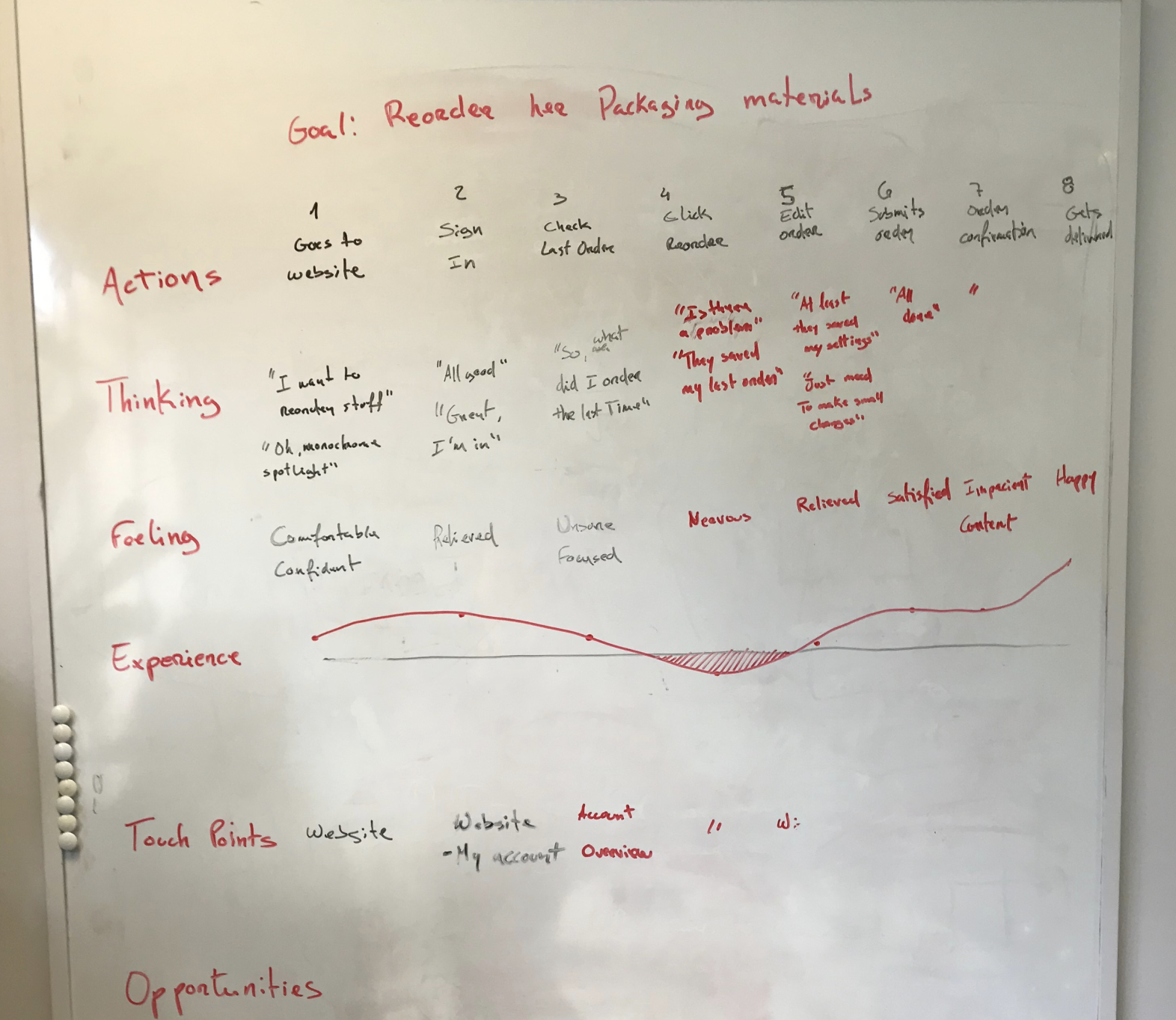
Pain points differed across customer types — casual buyers, SMB customers, and trade users had distinct needs.
Many used Printed.com as a third-party provider, making cross-device price checking and tracking essential.
Not being mobile-friendly was a visible and growing gap — particularly for on-the-move checks.
04 — Strategic decisions
Three principles shaped everything that followed.
Before any design work began, we used the research to define a set of guiding principles — a strategic position that would resolve the expert vs. novice tension and give the team a consistent north star throughout the project.
Principle 01
Support that doesn't intrude
Supporting information had to be available but not always visible. Progressive disclosure for novices; clean speed for experts. One interface, two modes of use.
Principle 02
Functional but human
Tone of voice had to be friendly and jargon-free without being condescending. Print terminology was retained where necessary — but always explained in plain language nearby.
Principle 03
Mobile as a first-class experience
Not being mobile-friendly was a missed opportunity the research made undeniable. A responsive, mobile-first approach was a strategic requirement, not an optional enhancement.
On the brand side, I made the decision to outsource the visual identity to creative agency Lovegunn, while keeping UX design in-house. Running both workstreams simultaneously — against BAU commitments — required tight coordination and a clear handshake between brand values and UX language.
05 — The design
A new brand and a rebuilt platform — launched together.
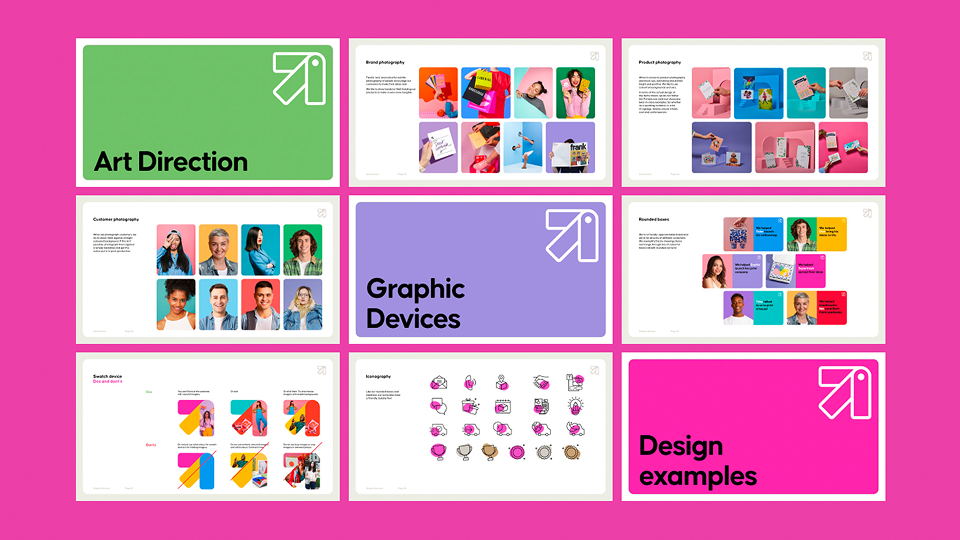
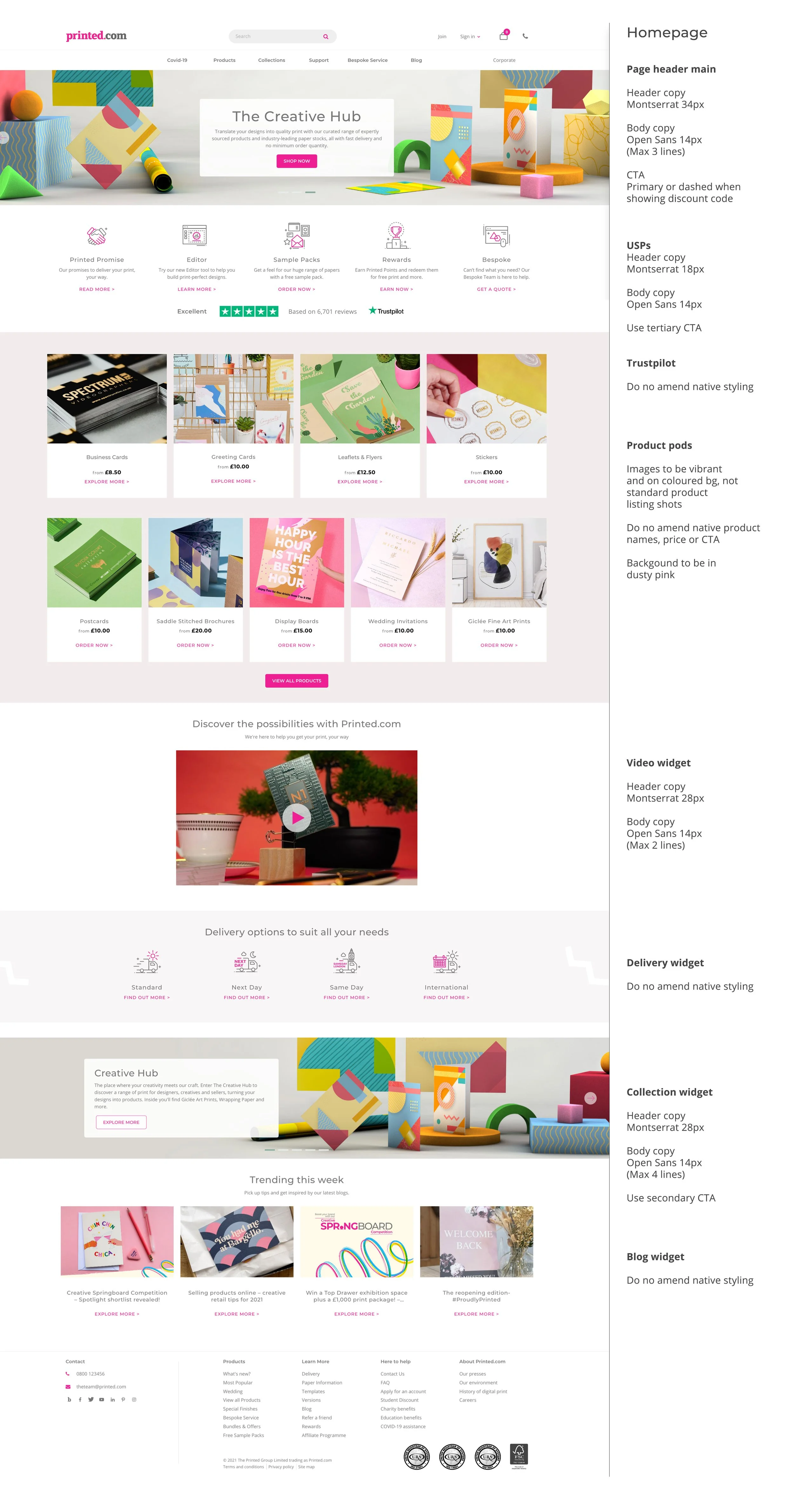
The rebrand introduced a new icon built on dual imagery — designed to resonate with both novice and expert customers. New values placed quality and creativity at the forefront, supported by a more vibrant colour palette and the domain name retained prominently in the brand mark.
⚙️
Product builder — rebuilt
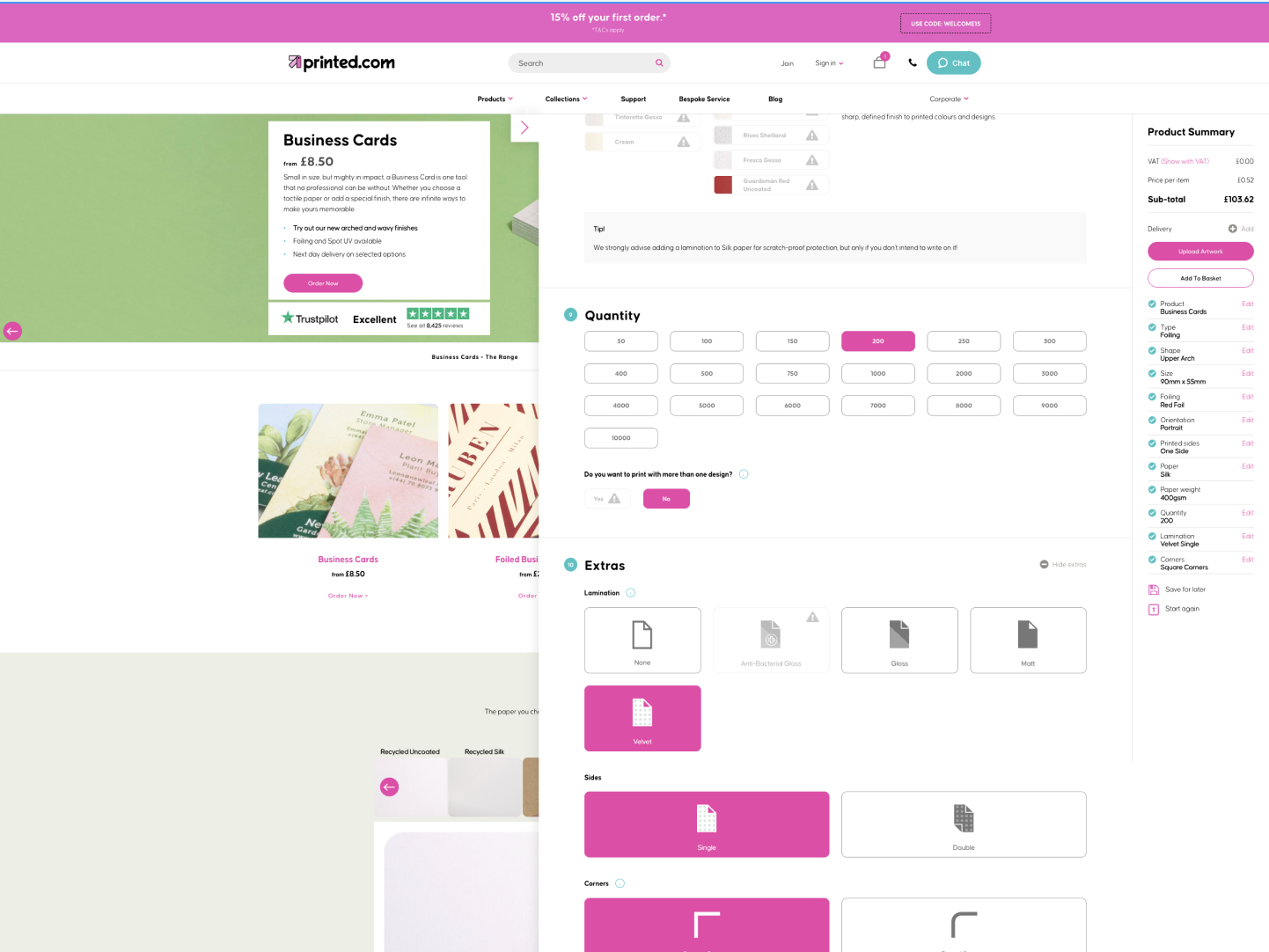
The most-used feature in the entire journey. Redesigned to be intuitive for first-time users without slowing down experienced ones.
💷
Dynamic pricing
Live cost updates as customers configure products — directly addressing the top frustration from our research.
📋
My Account — redesigned
Invoices, quotes, and order history in one coherent place — replacing a system described as cumbersome by nearly every user interviewed.
📱
Mobile-friendly checkout
A streamlined, responsive checkout with turnaround time surfaced upfront — not hidden until the final step.
🎨
Visual identity refresh
A fresh, modern brand that finally matched the quality of the product — vibrant palette, clearer typography, quality and creativity at the forefront.
💬
Support visibility
Customer support — a genuine competitive strength — made visible throughout the journey via contextual help, without cluttering the experience for confident users.
06 — Outcomes
We hit the target. Then exceeded it.
The objective was a 20% improvement in conversion. The results came in above that — and the impact extended well beyond the primary metric.
+22%
Conversion rate increase in Q1 after launch
vs. 20% target
+18%
Improvement in customer satisfaction via NPS
Post-launch score
−50%
Reduction in reprint requests — a proxy for product builder clarity
Reprints halved
🥉
Bronze Transform Award — Best Visual Identity, Retail Sector
Industry recognition
🏆
Bronze Transform Award — Best Visual Identity from the Retail Sector
Industry recognition for the Lovegunn partnership and in-house UX work delivered simultaneously across brand and platform.
The halving of reprint requests was perhaps the most meaningful signal — direct evidence that the redesigned product builder and clearer language made the ordering process genuinely understandable for customers who would previously have made costly mistakes.
07 — Reflection
What I'd do differently.
What worked
Running research before any design decisions. The split between novice and expert users wasn't an assumption — it came directly from interviews, and it shaped every subsequent decision. Without that grounding, we'd have designed for the customers we assumed we had, not the ones we actually served.
What worked
The decision to outsource branding to Lovegunn while keeping UX in-house. It let both teams operate at full quality simultaneously without one compromising the other — though it required disciplined coordination to ensure brand and UX languages remained aligned throughout.
What I'd change
Running the rebrand and platform redesign simultaneously against BAU commitments was the biggest operational challenge. In hindsight, a more explicit resource plan — with BAU deprioritised formally rather than managed reactively — would have reduced the pressure on the team significantly.
What I learned
Designing for a wide user spectrum is fundamentally a prioritisation challenge. You can't serve everyone equally in every moment. The answer was progressive disclosure: make it simple by default, and available when needed. That principle held across every feature we shipped.