
Betway x Formula 1
A live betting experience built for race day
Pitching for and winning the official F1 betting partnership — then designing and launching a real-time in-race betting hub covering live telemetry, driver and team stats, session switching, and in-play markets across a global contract.
Formula 1 had become the fastest-growing sport in the world. Betway wanted to be at the centre of it.
Formula 1's global audience had exploded — driven by a new generation of fans who were deeply engaged, data-hungry, and hungry for ways to interact with the sport beyond watching. The existing sports betting experience wasn't built for F1. Standard race winner markets didn't reflect the nuance of a sport where qualifying, pit strategy, safety cars, and sector times all shift the outcome in real time.
The opportunity was significant: become F1's first official betting sponsor, and build an experience worthy of the partnership — one that brought the sport's rich live data into the betting product in a way no competitor had attempted.
"Design a betting experience that makes Betway the natural home for F1 fans — and win the contract to become Formula 1's first ever official betting partner."
My role spanned the pitch itself and the subsequent launch — leading on marketing strategy and partnership positioning, while working in close collaboration with the UX team to shape the new F1 hub and its live in-race betting functions.
Three months to design, pitch, and win a global contract.
The timeline was punishing. From initial brief to pitch presentation, we had three months — covering market research, partnership strategy, concept design, and a full product vision for an experience that didn't yet exist anywhere in the industry.
The pitch had to do two things simultaneously: convince Formula 1 that Betway understood their audience and brand, and demonstrate that the product we were proposing was genuinely buildable and genuinely differentiated. Decks alone wouldn't win this — we needed to show the experience.
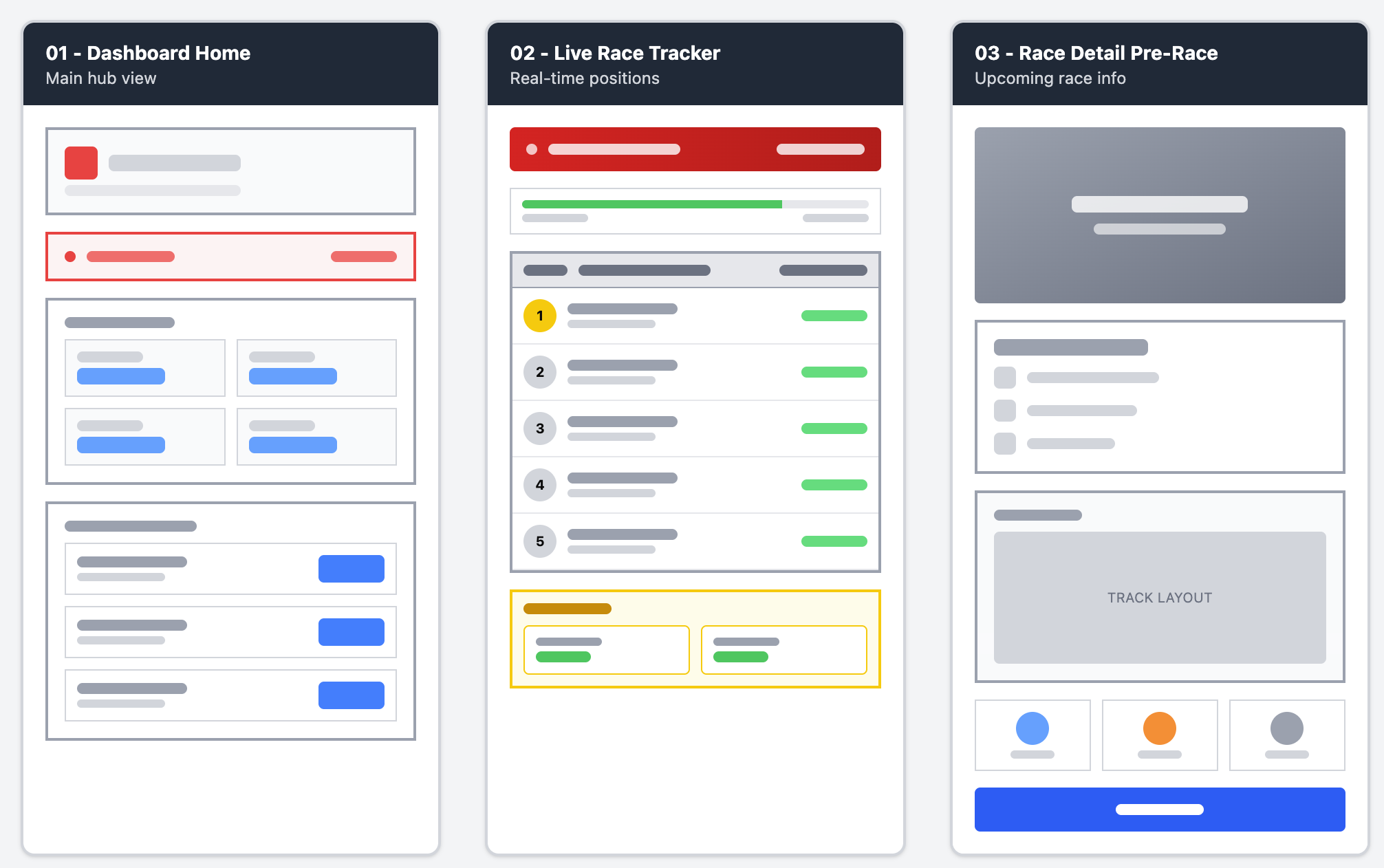
Not just a market list. A race day companion.
The design vision was to move far beyond a standard list of F1 betting markets — and create something that felt like it belonged inside the sport. The F1 hub would be a dedicated environment that users entered before the weekend began and stayed inside throughout qualifying, practice, and race day.


Real-time data that moves markets. In-play betting that moves with the race.
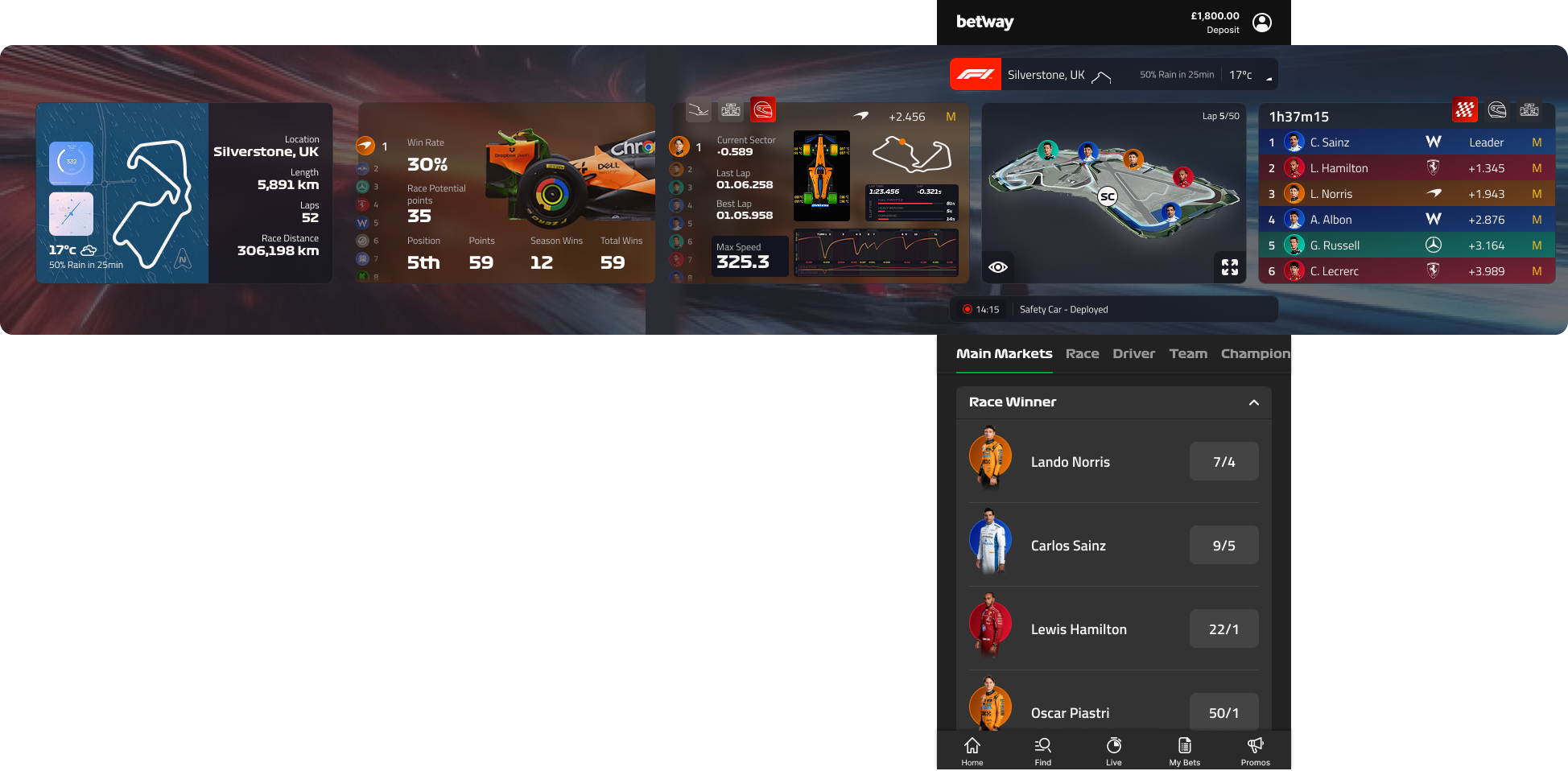
The live race experience was the centrepiece of the product vision — and the most technically ambitious part of the design. During a race, everything changes: gaps open, safety cars deploy, tyre strategies diverge, and the race winner can shift multiple times in a single lap. The in-play betting experience had to reflect this dynamism, not flatten it.
The live view combined a real-time track map with the current lap count and time, a live driver leaderboard with gap-to-leader data, a scrolling team radio and sector time feed, and in-play betting markets — all visible simultaneously, without requiring the user to toggle between separate tabs or screens.
The choices that made the experience feel like F1, not just sports betting.
Designing for a live sport with this level of data complexity required a set of deliberate decisions about hierarchy, density, and what to surface when — especially on mobile, where the majority of in-race betting happens.
| Decision | Rationale | Alternative considered |
|---|---|---|
| Dedicated F1 hub — separate environment, not a market category | F1 fans arrive with a race-day mindset. A dedicated hub — with its own visual language, navigation, and data feeds — signals that Betway takes the sport seriously. A standard sports category page wouldn't. | F1 as a sport category within the main nav — familiar but generic, and unable to house the live data layer the experience required. |
| Session-aware layout: Practice, Qualifying, Race each have distinct views | Qualifying and race betting are fundamentally different propositions. Surfacing session-appropriate markets automatically reduces user effort and increases bet relevance. | Single static market list across all sessions — simpler to build, but misses the contextual opportunity that makes F1 betting compelling. |
| Live track map as primary race orientation device | The track map gives users instant spatial context — where each driver is, where the safety car is deployed, and which sectors are being contested. It anchors all other live data and markets. | Driver leaderboard only — cleaner, but misses the drama of position and gives no sense of race dynamics. |
| Driver and team stat cards as market entry points | F1 fans think in terms of drivers and teams, not market categories. Tapping Sainz should surface Sainz's markets alongside his stats — not take the user to a generic list. | Markets-first navigation — follows standard sportsbook logic but loses the F1-specific engagement that drives session time. |
| Recommended bets surfaced during the race, not before it | Live race conditions create the most compelling betting moments — a safety car, a pit stop, a fastest lap. Surfacing contextual recommendations in real time captures this. Pre-race suggestions don't. | Recommended bets as a static pre-race feature — lower engineering complexity but misses the highest-intent moments in the user journey. |
| Championship Outrights always accessible from the hub | Season-long bets are a core F1 proposition. Keeping Drivers and Constructors outrights one tap away from any race view encourages cross-session engagement beyond individual race markets. | Outrights buried in a separate section — users who want them find them, but casual discovery is lost entirely. |
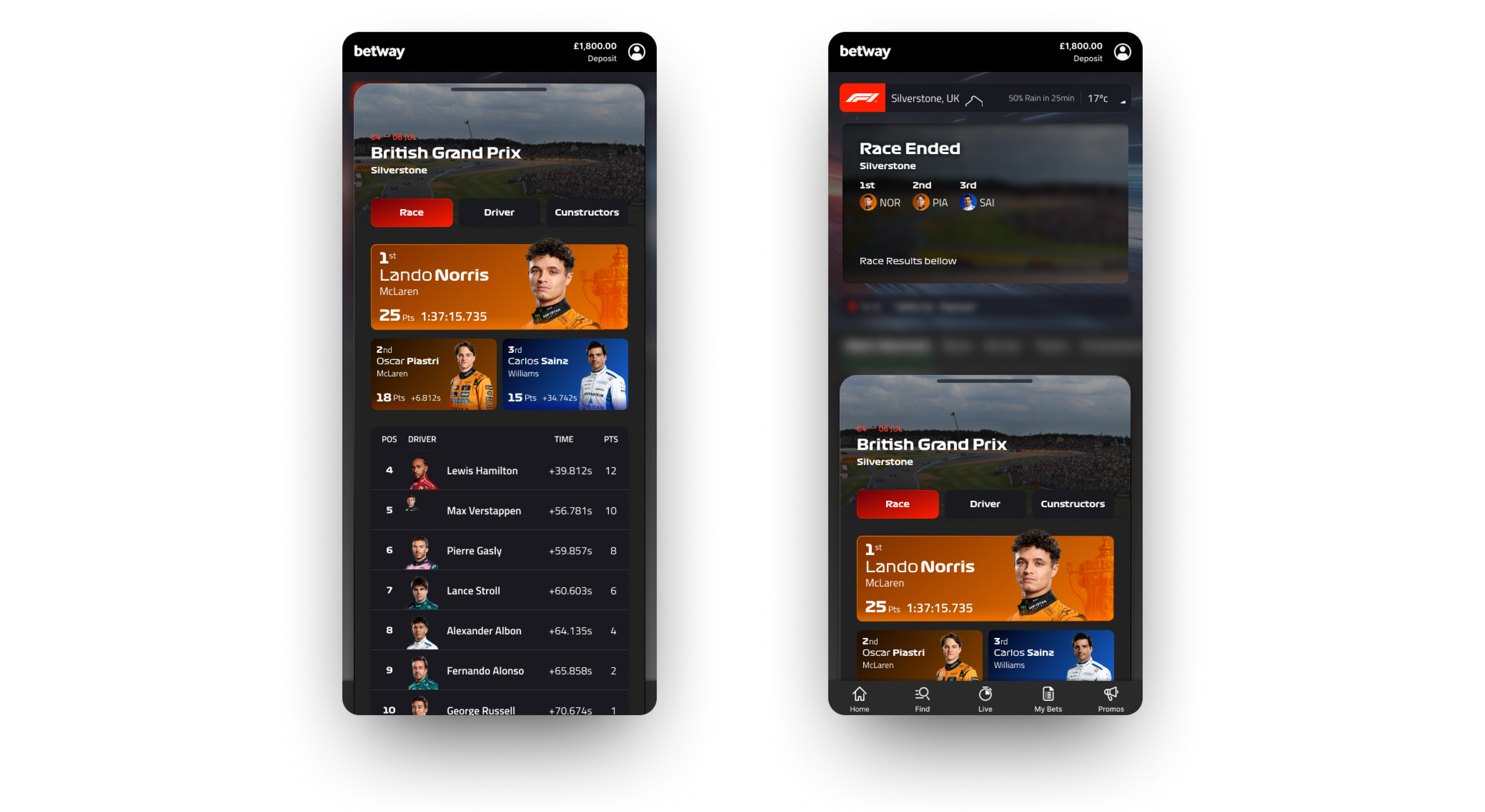
Winning the contract was only the beginning.
Once the pitch was won, the focus shifted from convincing Formula 1 to activating the partnership with its global audience. My role in this phase was to lead the marketing strategy and creative direction for the launch — making sure the Betway x F1 announcement landed with the weight the partnership deserved.
The launch had to work across a global footprint of markets simultaneously — from the UK to Asia Pacific — with localised activation where required, all anchored to a single coherent brand story: Betway is now the home of Formula 1 betting.


Contract won. Partnership live. Global from race one.
The pitch was successful — Betway became Formula 1's first ever official betting partner, a landmark moment for the brand and a commercial outcome that validated both the marketing strategy and the product vision presented.
The F1 hub is still being developed for the 2026 season — bringing live telemetry, session-aware markets, driver and team cards, real-time recommended bets, and championship outrights into a single dedicated experience for Betway's global F1 audience.
