
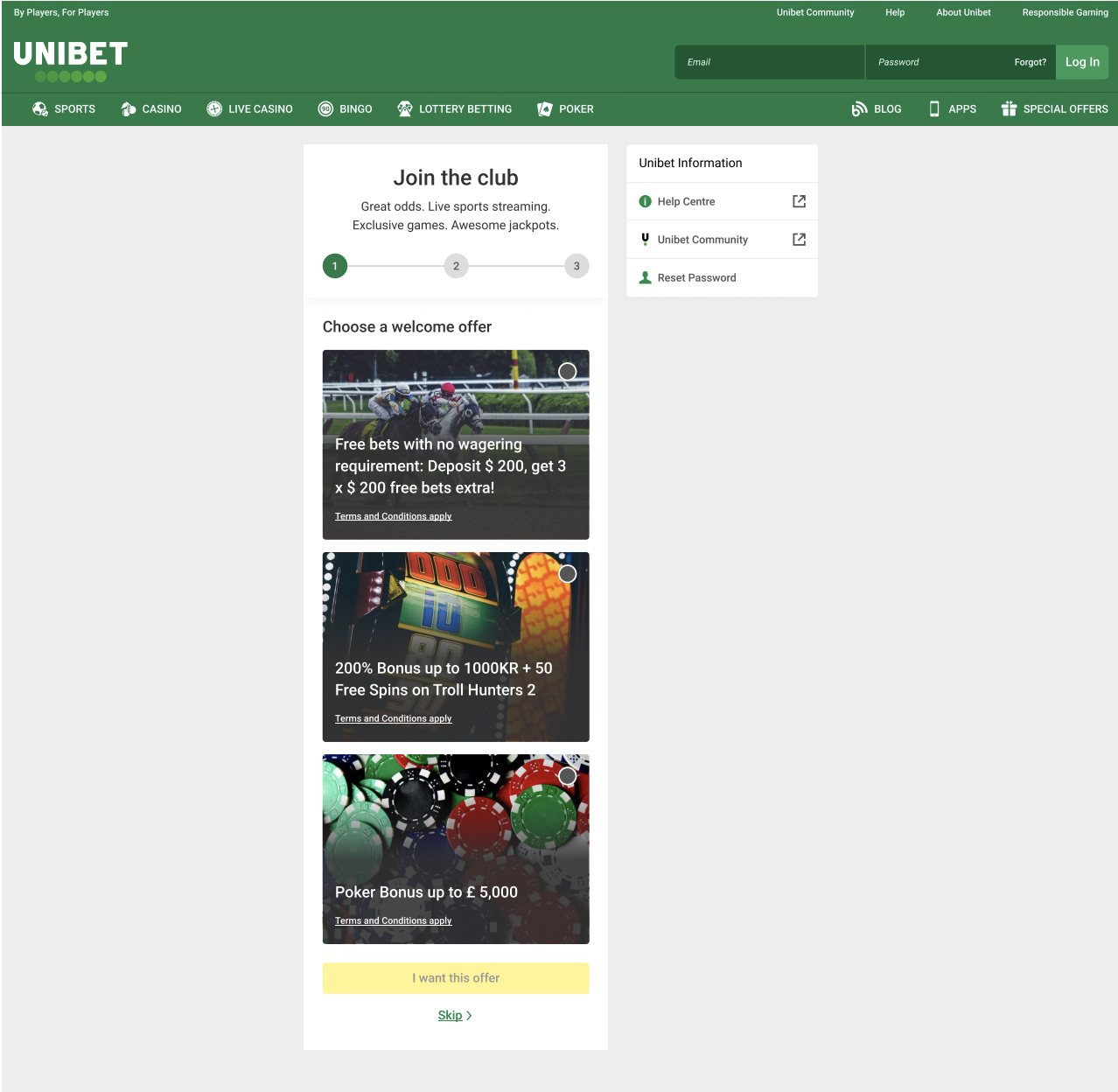
Registration mini app for
four brands in five markets
Designing a flexible, compliant sign-up flow that could scale across regulated gambling markets — from Norway to New Jersey — without fracturing into siloed, unmaintainable codebases.
Client
Kindred Group
(Now part of FDJ United)
Objective
Unify fragmented registration flows into one scalable, compliant system.
My role
Product Design Manager
Output
A responsive registration mini-app across 5 markets, 4 brands, 3 breakpoints.
The Problem
Online gambling companies operate in some of the most heavily regulated digital environments in the world. Each of the relevant jurisdictions — carries its own licensing rules, identity verification requirements, age-gate thresholds, responsible gambling obligations, and mandatory disclosures. The existing approach was a patchwork: each market had been built out separately, with shared logic copied and diverged over time. Onboarding a new market meant months of custom engineering. Updating a legal clause meant touching four codebases.
Every market wanted their own registration. That was not suitable.
As Product Design Manager, I led a cross-functional team of product designers, UX researchers, and product writers to design a modular "mini-app" architecture: a baseline flow that worked everywhere, with market-specific steps slotted in as required.
Design Challenge
"How do we build one registration system that feels native to every market — without making a single compromise on compliance or conversion?"
Markets and Scope
Before designing anything, I led the team through a structured discovery phase — mapping every regulatory and UX difference across our target markets, and identifying which requirements were truly market-specific versus which had been duplicated unnecessarily.
🇳🇴 Norway — baseline
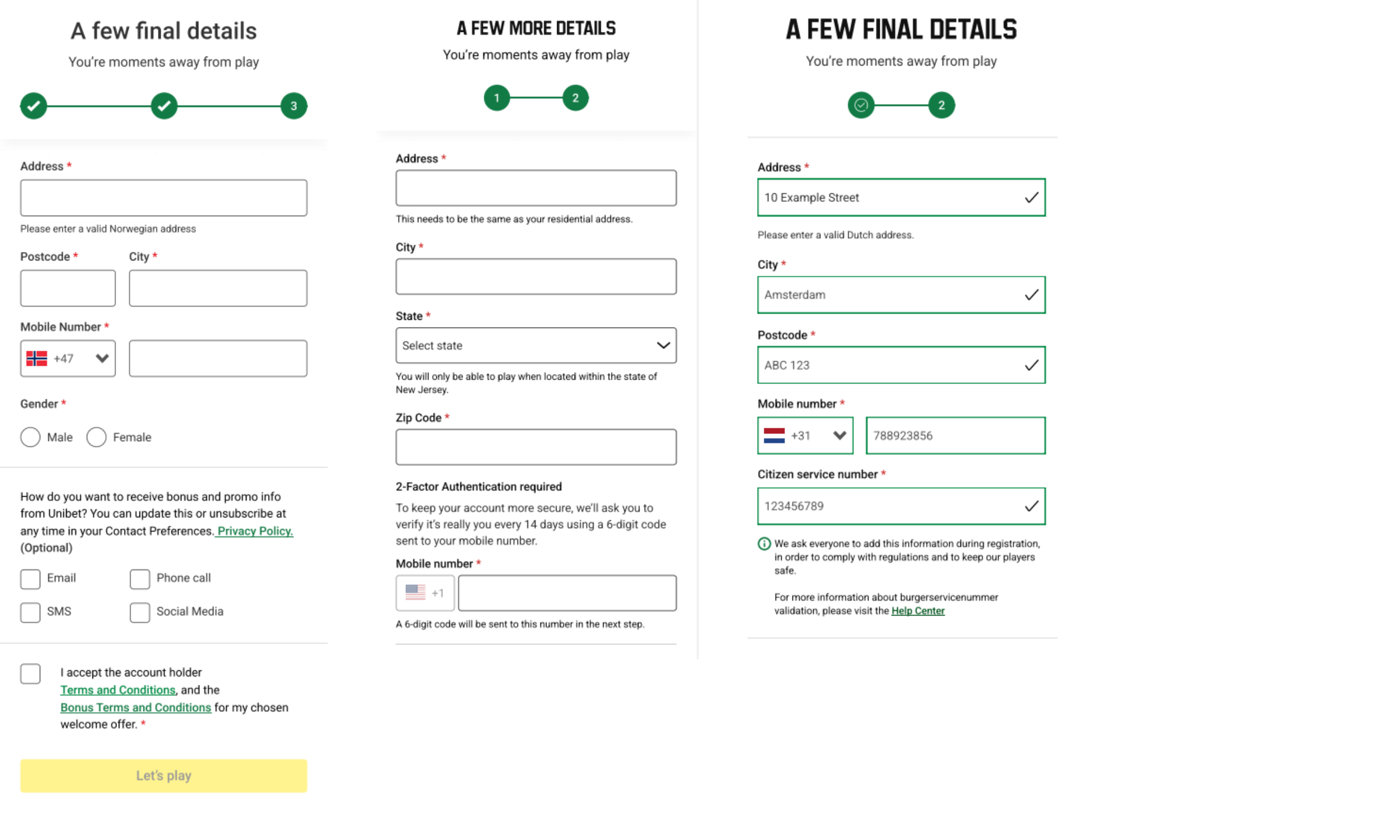
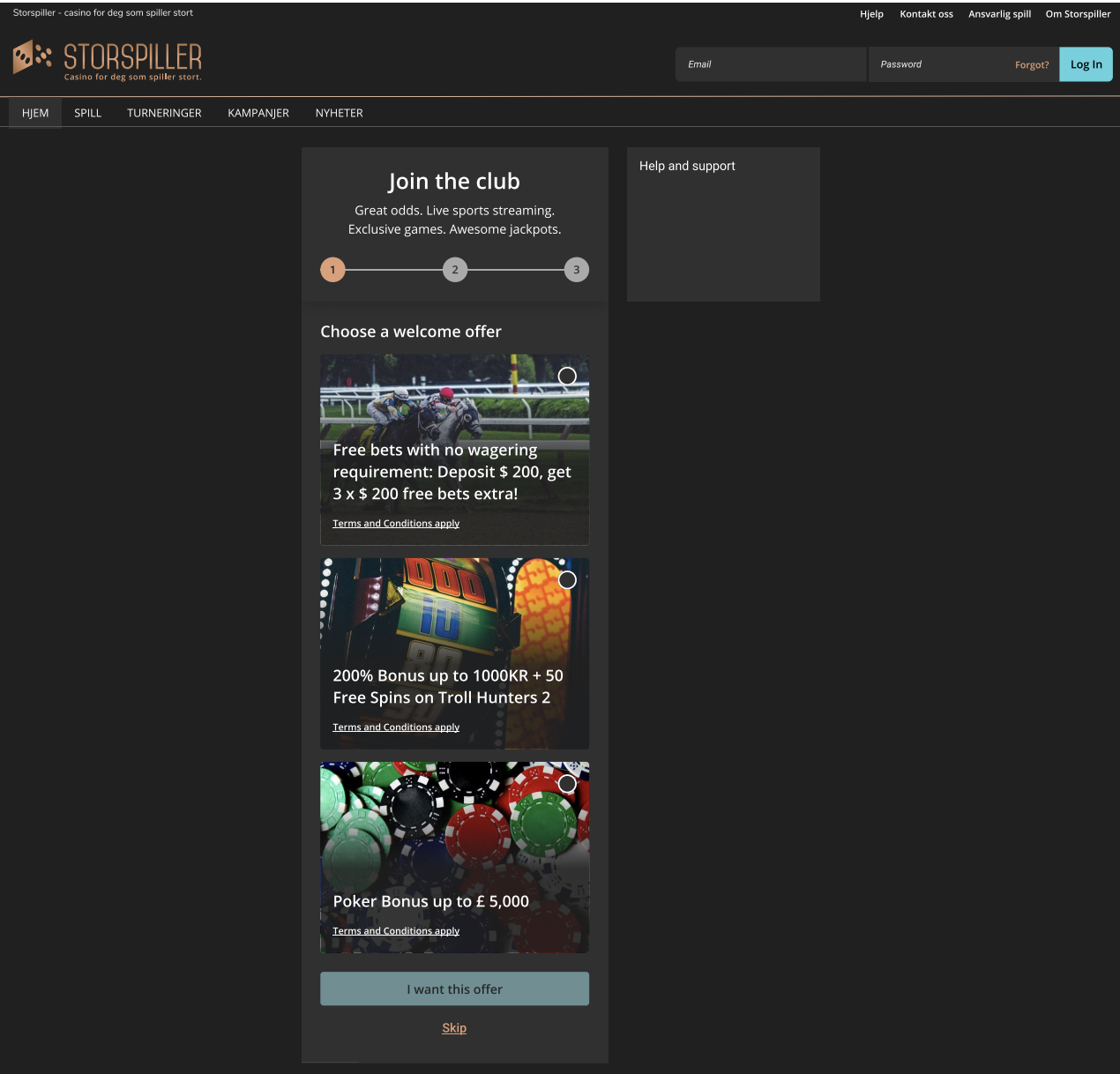
The base flow. Three-step registration: welcome offer, account creation, personal details. No additional identity requirements.
🇩🇪 Germany
Added country of residence gating, promo code entry, and redirect logic if the user selects Austria or Switzerland.
🇳🇱 Netherlands
Most complex: iDIN bank verification integration, Citizen Service Number (BSN), contact channel verification, and responsible gambling limit-setting.
🇺🇸 New Jersey
US compliance layer: last 4 digits of SSN, 21+ age gate, state geo-lock, mandatory employee non-compete disclosures, 2FA, and LexisNexis identity check.
Brands
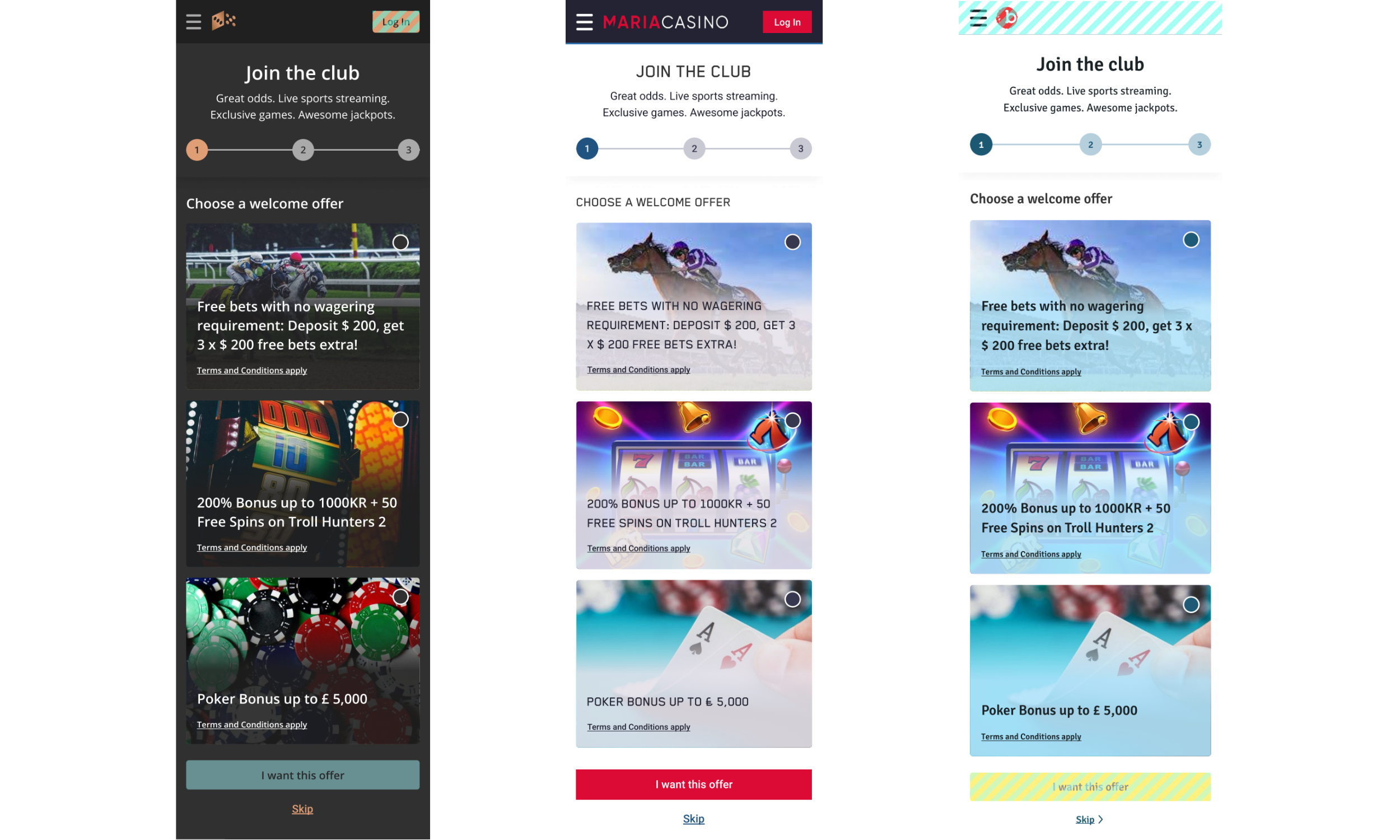
Each brand applied its own visual language on top of the same structural foundation — a constraint that required designing with brand-agnostic components skinnable without any layout changes.
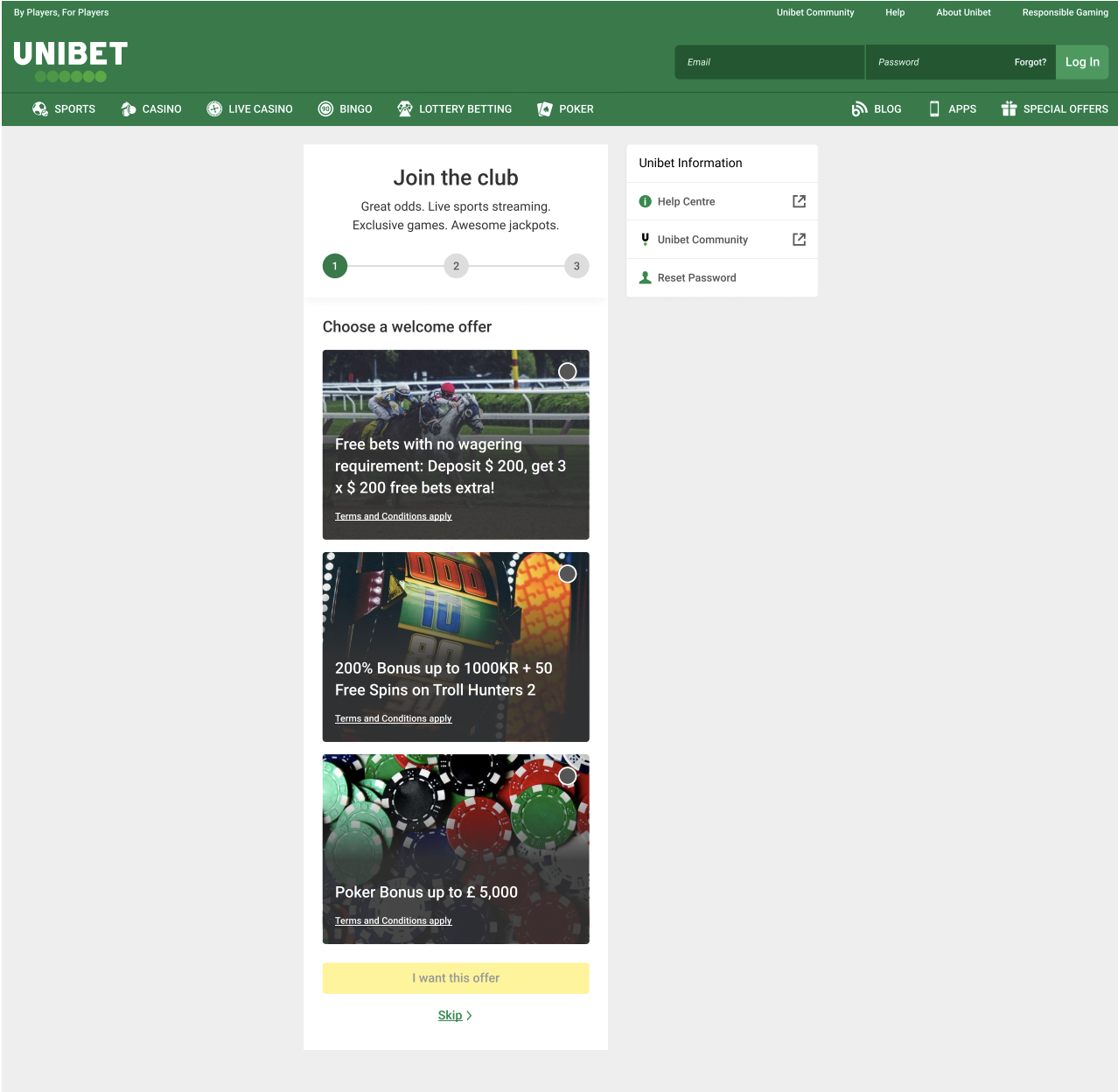
Unibet
All markets
Maria Casino
Norway
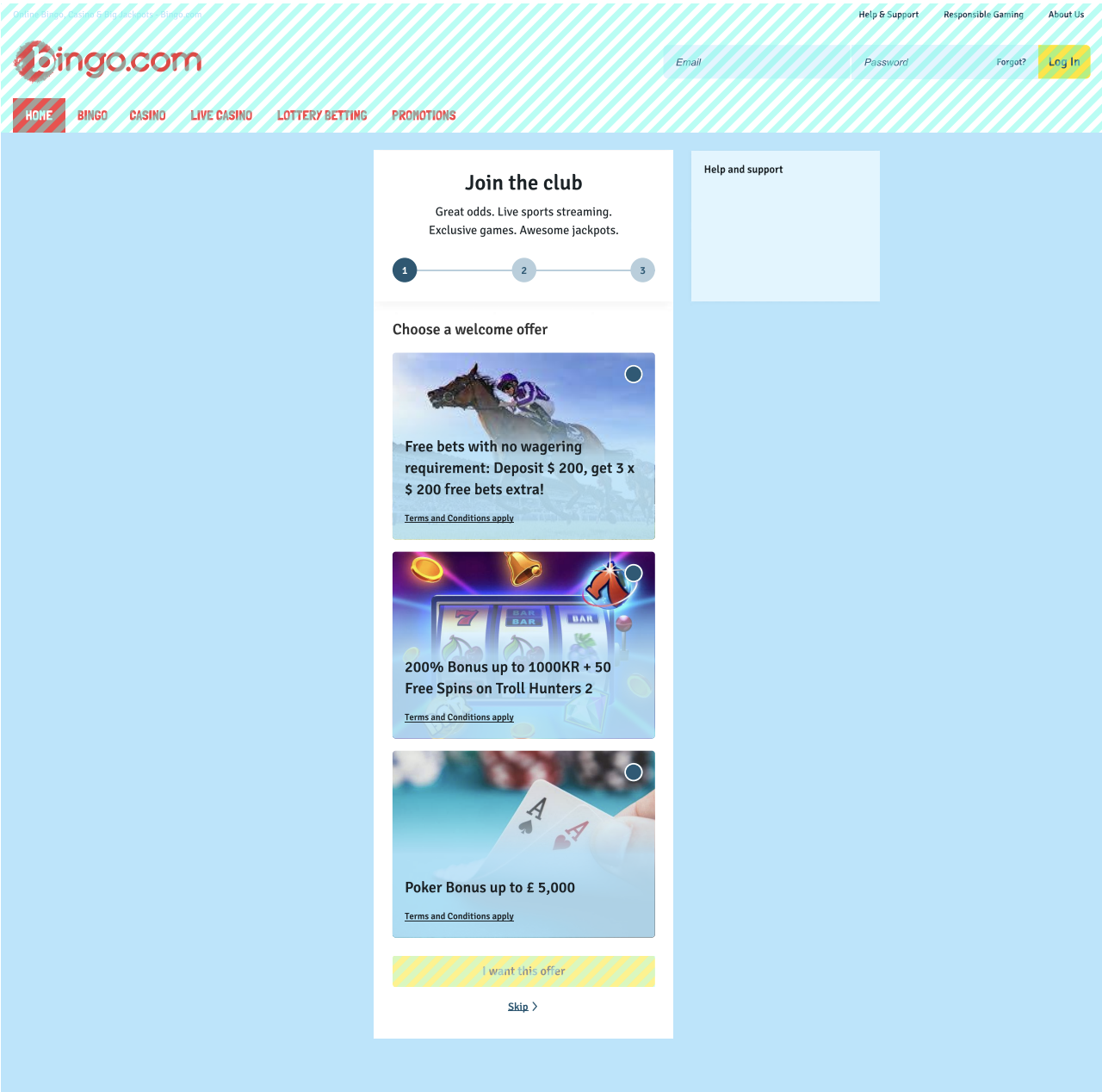
Bingo.com
Norway
Highroller
Norway
Process
I directed the team to design the Norway baseline to exhaustive completeness before touching market variants — every state, breakpoint, error condition, and edge case. This created a reusable template that each market extension could be measured against.
Step 1
Welcome offer selection
Users choose a bonus offer upfront to anchor motivation before the friction of data entry begins.

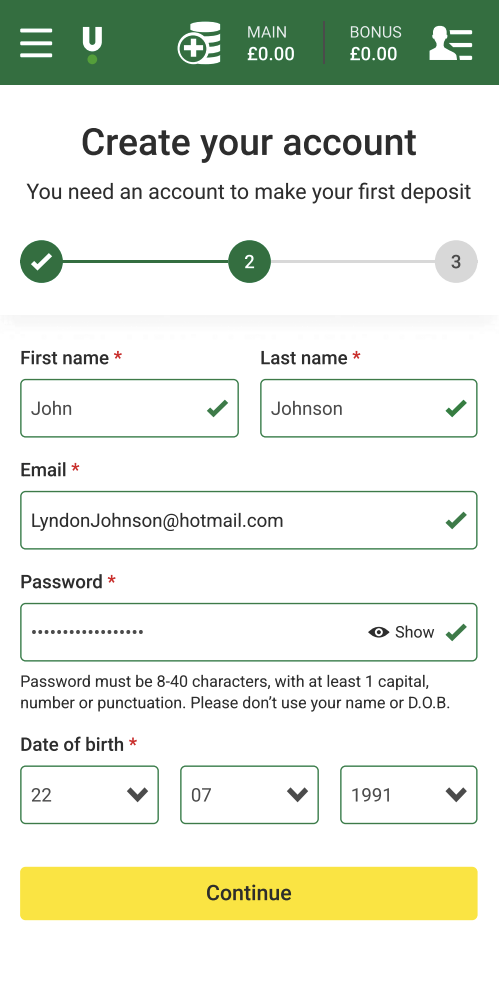
Step 2
Account creation
Core personal details: name, email, password, date of birth. Market-specific fields injected here as needed.
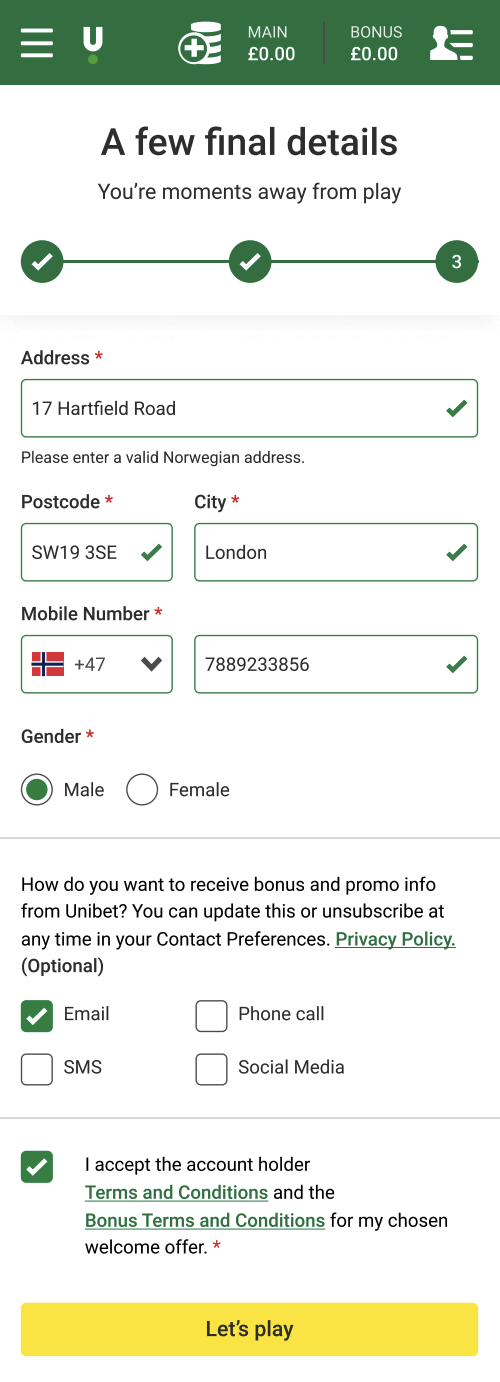
Step 3
Final details
Address, phone, marketing preferences, and compliance checkboxes. Varies most significantly by market.
Research told us that most first-time users arrived having already seen a welcome offer in an upstream marketing journey. Placing offer selection first reinforced that motivation and gave users a reason to push through the form — rather than introducing the offer as a reward at the end, when drop-off is highest.
Key design decisions
What we chose not to do mattered as much as what we built. Several decisions shaped the architecture in ways that aren't visible in the final screens but significantly affected both usability and engineering feasibility.
-
UX research confirmed most users arrived having already seen the offer. Surfacing it first reinforced their motivation before introducing data-entry friction.
-
Eliminates a redundant action once the user has already initiated registration. Reduces visual noise at a critical moment.
-
Keeps users in context for the highest-friction consent moment. General legal documents benefit from a full reading environment.
-
Bank-verified identity reduces post-registration KYC drop-off and manual document review overhead.
-
Reduces abandonment caused by opaque form errors. Every failure surfaces a specific, actionable message.
One system. Every market. Delivered.
The completed design spec covered the full registration experience across all five markets and four brands, at three responsive breakpoints, including all states, errors, and edge cases. Post-launch measurement confirmed meaningful improvement on the metric that matters most for a registration flow.
-19%
Reduction in registration abandonment after launch
Measured against pre-redesign baseline
4x
Faster to onboard a new market vs. the previous siloed approach
Estimated engineering delta
60+
Distinct screen states documented across all markets and breakpoints
Including error, filled, and edge-case views
The modular architecture proved its value immediately: when Netherlands launched with iDIN requirements and New Jersey added SSN and 2FA obligations, both were inserted into the existing flow as additive steps — with no redesign of surrounding screens required.
Reflections and learnings
What worked
Designing the Norway baseline to exhaustive completeness before touching any market variant. Every edge case the team caught there saved rework across four other markets. The investment paid back many times over.
What I'd change
Earlier and more structured involvement from legal and compliance teams per market. Several NJ and NL fields arrived mid-design, disrupting the form hierarchy. A more formal sign-off gate at the start of each market sprint would have prevented this.
What I learned
Regulated product design is as much about where you absorb compliance friction gracefully as it is about removing friction entirely. The best decisions here weren't about simplification — they were about placement and sequencing.